- Built at
- AITX & MLOps World
- Where
- Austin Tech Week
- When
- Oct 2026
Runway
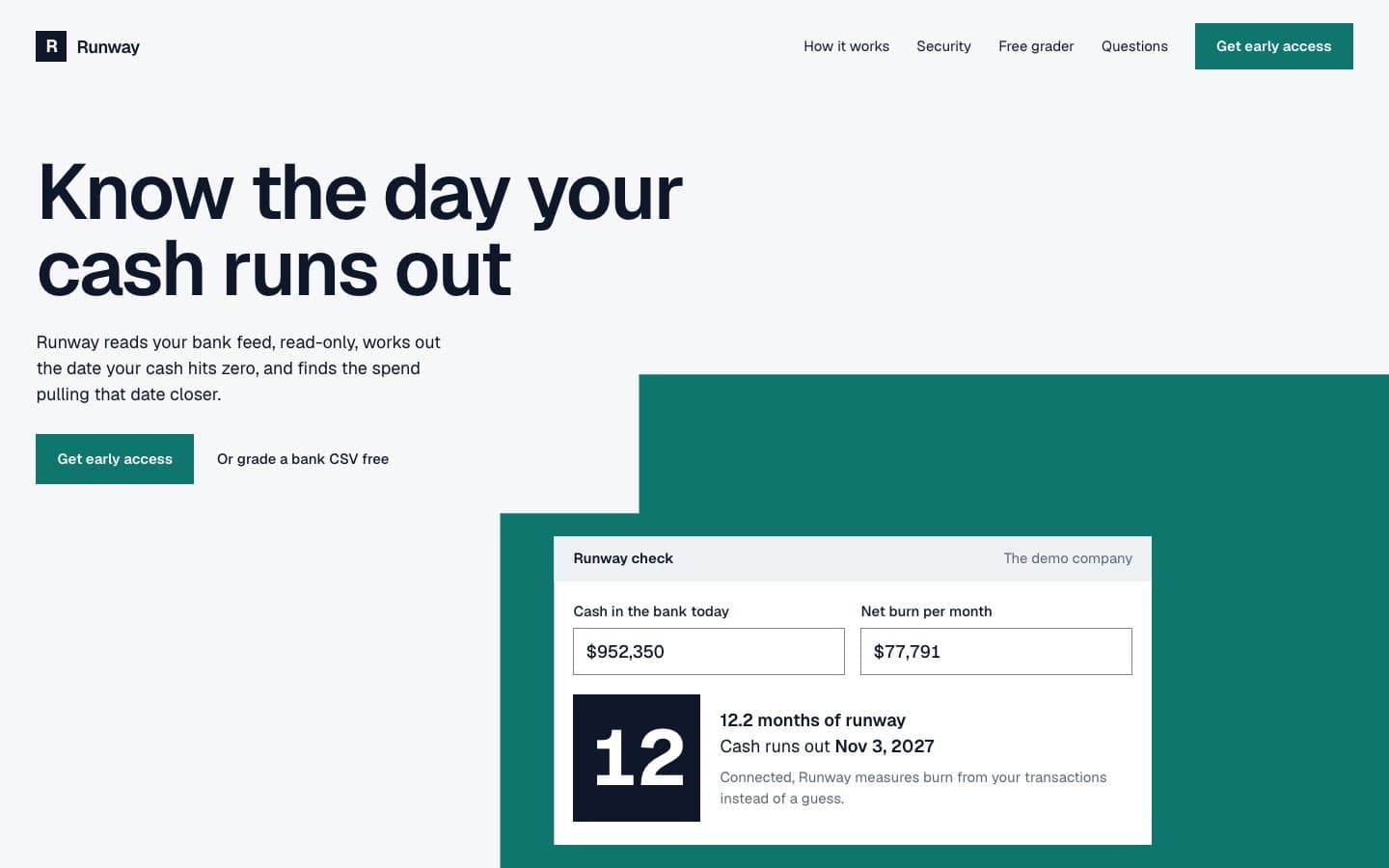
Know the day your startup's cash runs out, and find the spend pulling it closer.
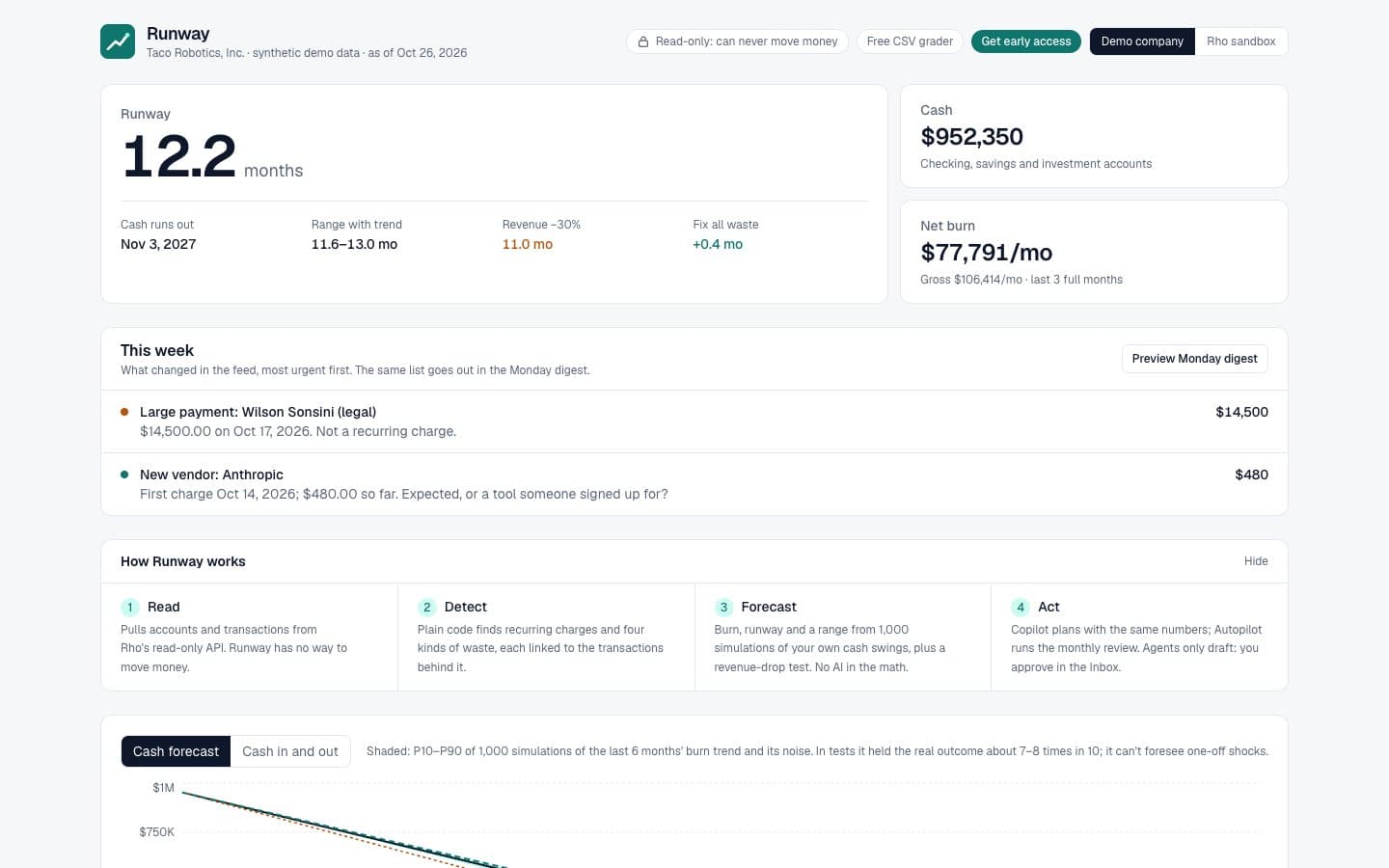
Runway reads a bank feed read-only, works out burn, runway and the zero-cash date with plain arithmetic, and finds wasted spend. Agents draft the fixes. A person approves every one.
- Flight
- Taco Robotics, the synthetic demo company
- Runway
- 12.2 months
- Cash out
- November 3, 2027
- Waste
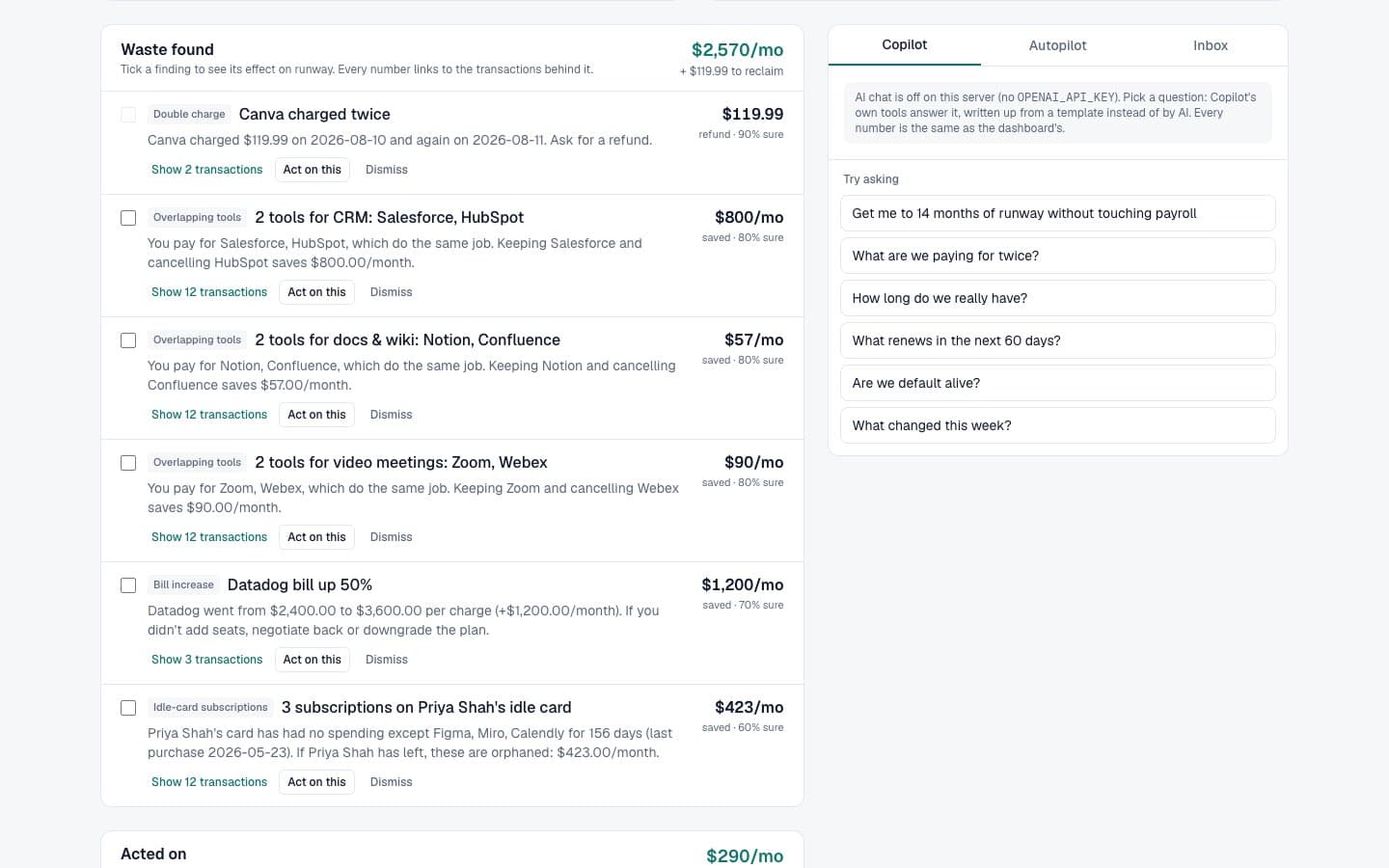
- $2,570 a month
- Status
- On time: no fixes applied
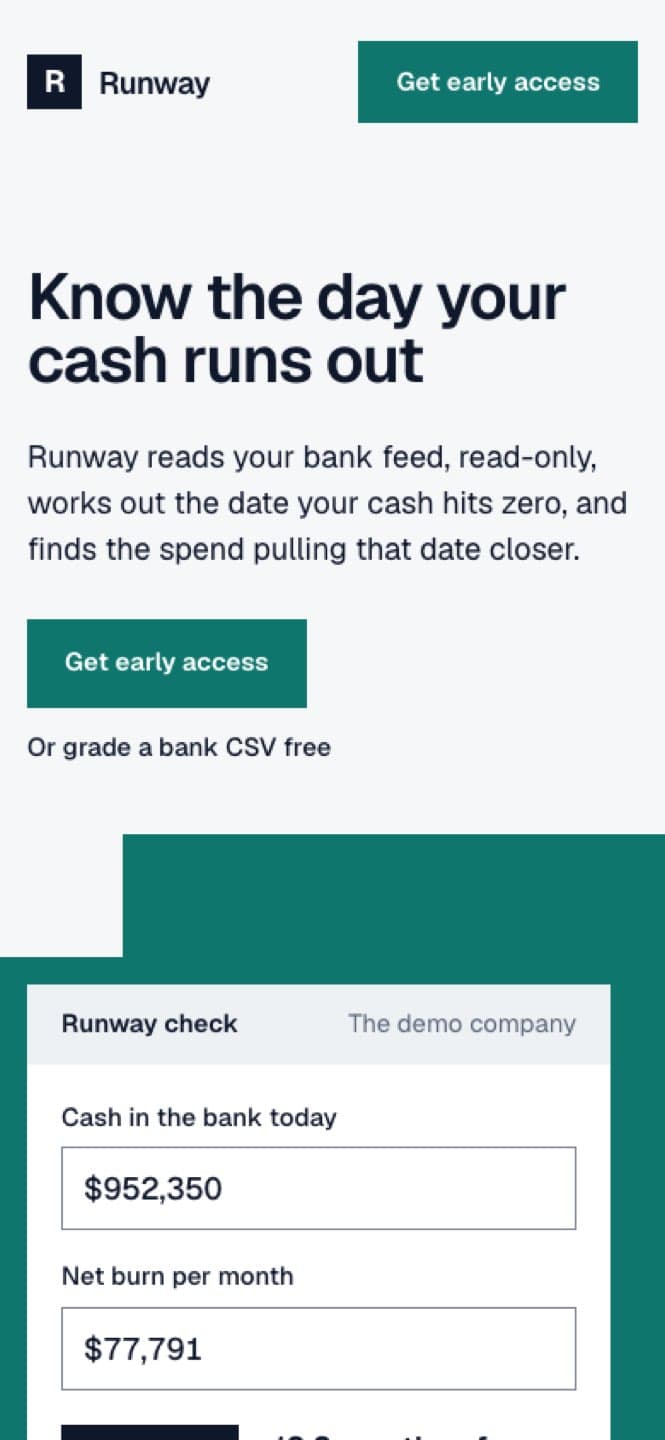
Taco Robotics, Inc. is Runway's synthetic demo company: 967 transactions, $952,350 in cash and $77,791 a month of net burn. Built at the AITX & MLOps World Community Hackathon, Austin Tech Week, October 2026, for the Rho Fintech and Antler Agents tracks. Now an independent early-access product, not affiliated with Rho.
Cancel the waste and watch the date move
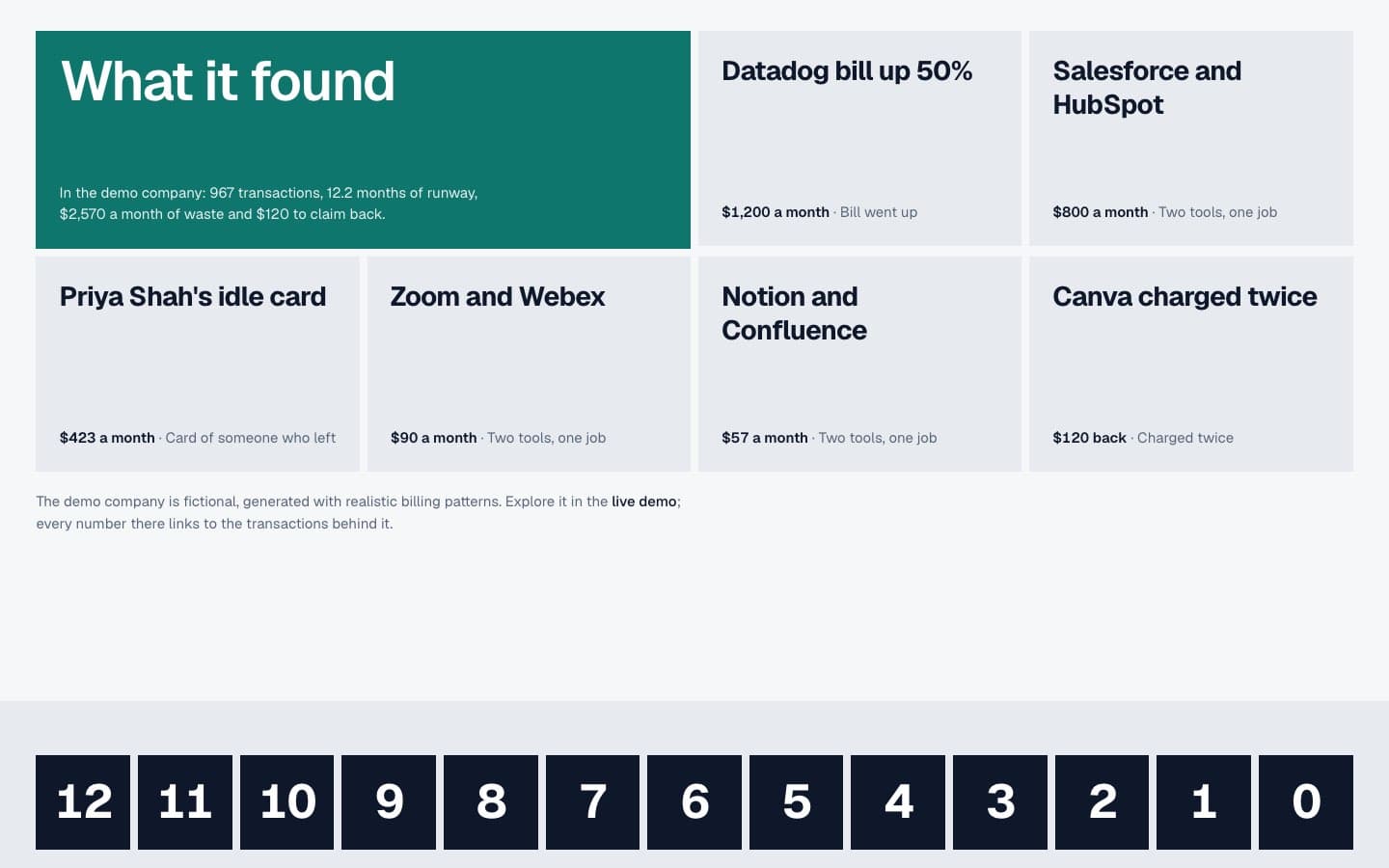
These are the six findings Runway pulled from the demo company's bank feed alone, with no receipts and no integrations: $2,570 a month. Flip them and the board re-flaps.
Cash runs out
November 3, 2027
- Runway
- 12.2 months
- Saved
- $0/mo
- Gained
- 0 days
- Refunds
- $0
Runway is cash divided by net burn minus what you stop paying. A refund adds to cash. Same numbers as the demo dashboard, worked out here in your browser.
Every month, one pair of lights goes out
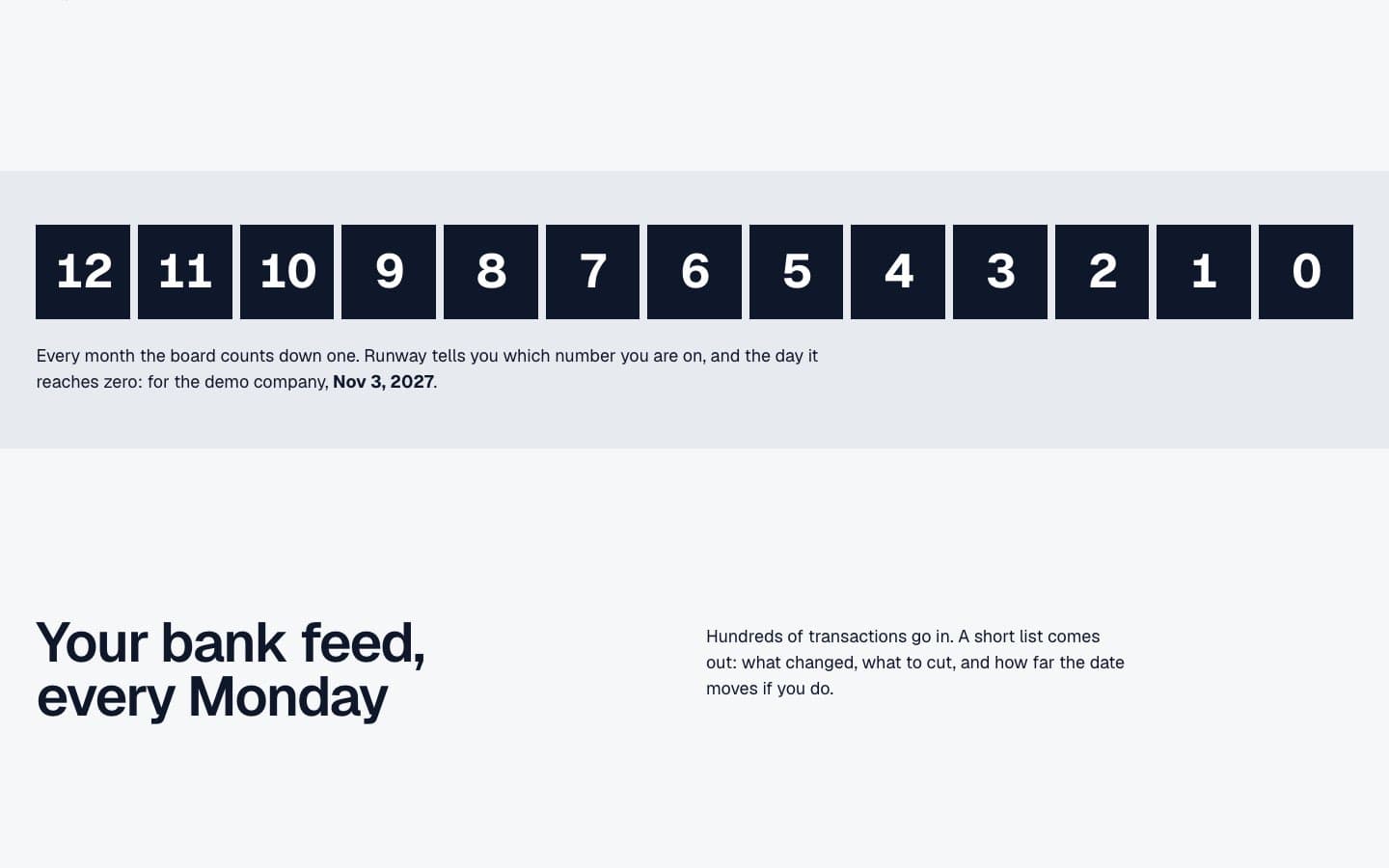
The product's own landing page counts a board down from 12 to 0. Here it is as a runway: scroll and the year plays forward. The far end is November 3, 2027.
12.2 months of cash leftas of Oct 2026
- 12Oct 2026lit
- 11Nov 2026lit
- 10Dec 2026lit
- 9Jan 2027lit
- 8Feb 2027lit
- 7Mar 2027lit
- 6Apr 2027lit
- 5May 2027lit
- 4Jun 2027lit
- 3Jul 2027lit
- 2Aug 2027lit
- 1Sep 2027lit
- 0Oct 2027lit
- 0.0Nov 3, 2027zero cash
A range to land in, not a single guess
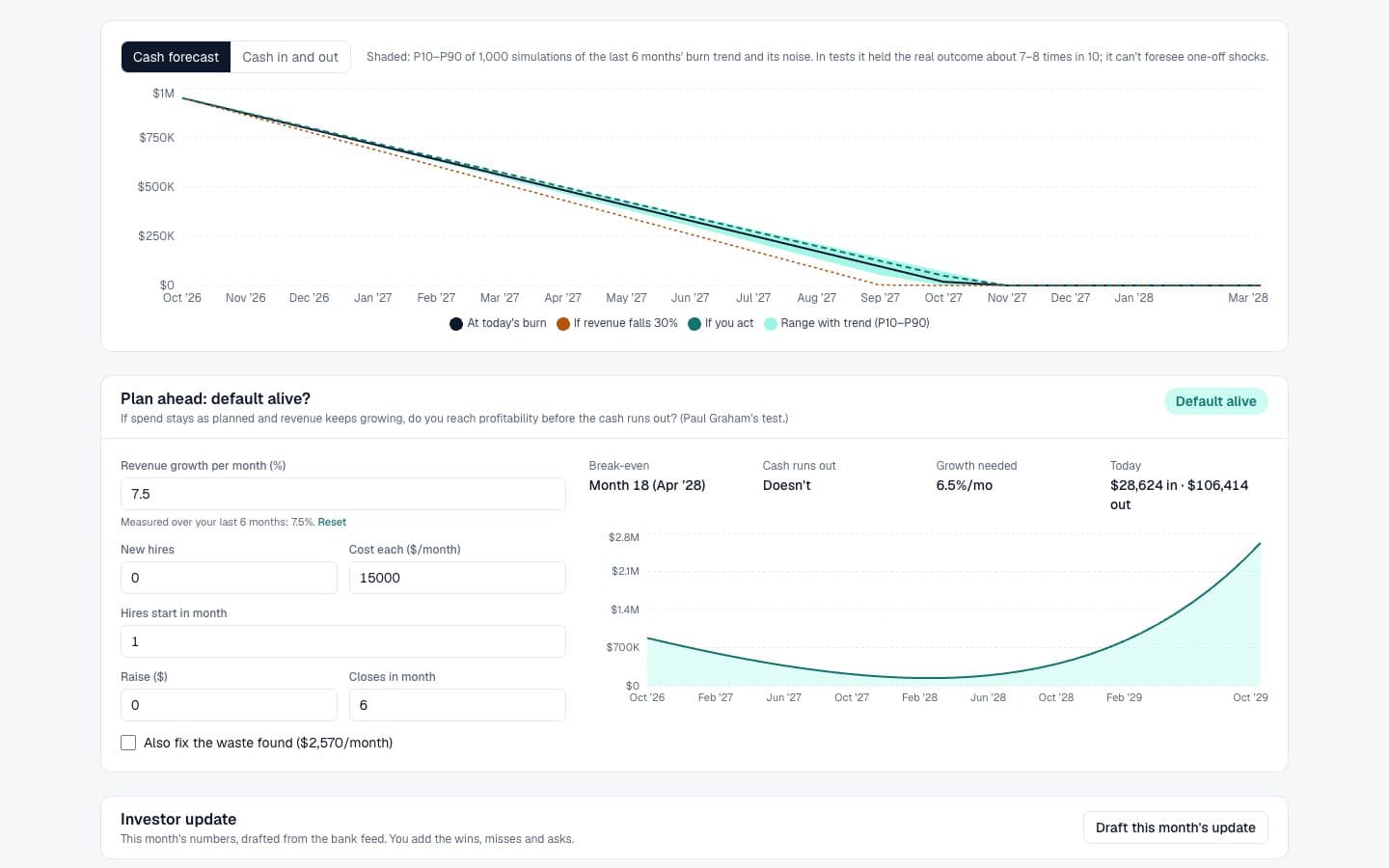
One number for runway is a guess. Runway runs 1,000 Monte Carlo paths on the last six months of burn and shows where 80% of them touch down, next to what happens if you act and if revenue falls 30%.
Agents draft. A person clears every one.
Autopilot runs a fixed plan, chosen before it reads any bank text, so a vendor name cannot steer it. Its memo is rejected unless every dollar figure matches the analysis, and the feed is read-only: it can never move money.
Autopilot · monthly reviewcomplete
SYNC       ok 967 transactions, read-only feed
ANALYZE    ok burn, runway, 4 detectors ~8 ms
FORECAST   ok 1,000 Monte Carlo paths ~10 ms
PLAN       ok steps fixed before any bank text is read
MEMO       ok every $/month checked against the math: pass
FILE_TASKS ok 6 drafts sent to the inbox, 0 sent out
HOLD       awaiting a person for every draft
Inbox, by dollar impact0 of 6 cleared
- Downgrade request to Datadog$1,200/mo · Hold short: awaiting approval
- Cancellation email to HubSpot$800/mo · Hold short: awaiting approval
- Jira ticket: cancel three seats$423/mo · Hold short: awaiting approval
- Refund request to Canva$119.99 back · Hold short: awaiting approval
- Cancellation email to Webex$90/mo · Hold short: awaiting approval
- Cancellation email to Confluence$57/mo · Hold short: awaiting approval
A replay for this page. Clearing here sends nothing. In Runway a drafted email or ticket goes nowhere until a person approves it, and savings only count once the next bill confirms the charge stopped.
The real thing, on the demo company
Screens from the live site. The recording shows findings being ticked on the dashboard and the runway updating as they go.
Ticking findings on the dashboard. No sound.
Rules first, models last
Everything that decides a number is ordinary code with tests. Models only name the rare vendor the rules miss, and draft text a person reads.
Bank feed, read-only
Paged, retried and checked with zod. The bank API it was built for cannot move money.
Vendors by rules
A vendor catalog and alias rules name about 97% of vendors with zero model calls. Unknowns go once to a small model, cached, forced into a closed list.
Plain arithmetic
Burn, runway and the zero-cash date in whole cents, from tested TypeScript. The model never does the math.
Four detectors
Overlapping tools, price increases, subscriptions on idle cards and double charges, from bank data alone.
Agents that draft
Copilot plans with the same pure tools. Autopilot runs a fixed plan. A database trigger rejects any agent action that is not a draft.
| Detector | Precision | Recall |
|---|---|---|
| Overlapping tools | 100% | 100% |
| Price increases | 100% | 100% |
| Idle-card subscriptions | 100% | 100% |
| Double charges | 100% | 100% |
Synthetic data only, not real ledgers: 5 seeds at 2 noise levels, with planted waste as ground truth. CI fails the build below 95%. A separately written held-out set found real defects (usage growth read as a price increase, at 43% precision), which were fixed.
- Speed
- ~950 transactions in 7–10 ms, Monte Carlo ~10 ms more
- Tests
- 396 unit tests, axe-core clean on the agent tabs
- Data
- Supabase Postgres, row-level security on every table, append-only audit log
- Free tool
- A CSV runway grader (opens in a new tab) that runs entirely in the browser; nothing is uploaded
- Stack
- Next.js, TypeScript, Tailwind, Vercel AI SDK, Supabase Postgres, Recharts, zod, vitest, Playwright