Type a code and press Enter, or pick a key.
DES <GO> · Independent build · Finance
YouBank
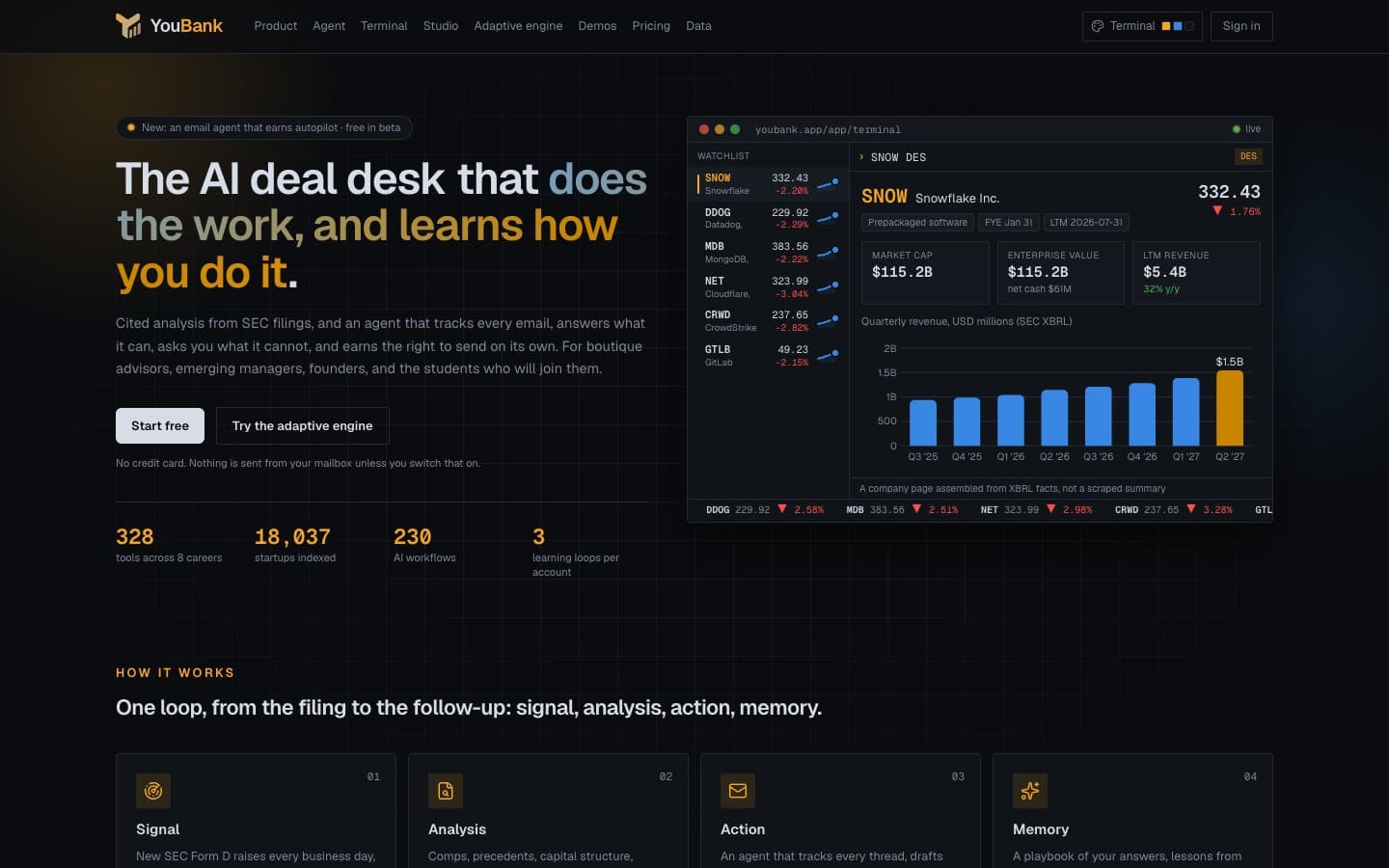
The AI deal desk that learns how you work.
It does the work and learns how you do it: a keyboard-driven research terminal on SEC data, a Studio that builds the model and the deck while you watch, and an email agent that has to earn the right to send on its own.
Free while in beta.
- terminal functions
- 35+
- tools: 230 AI workflows, 98 calculators
- 328
- recall@5, up from 0.85 with cross-encoder reranking
- 0.97
- of drafts go out unedited
- 90%+
- unit tests
- 1,000+
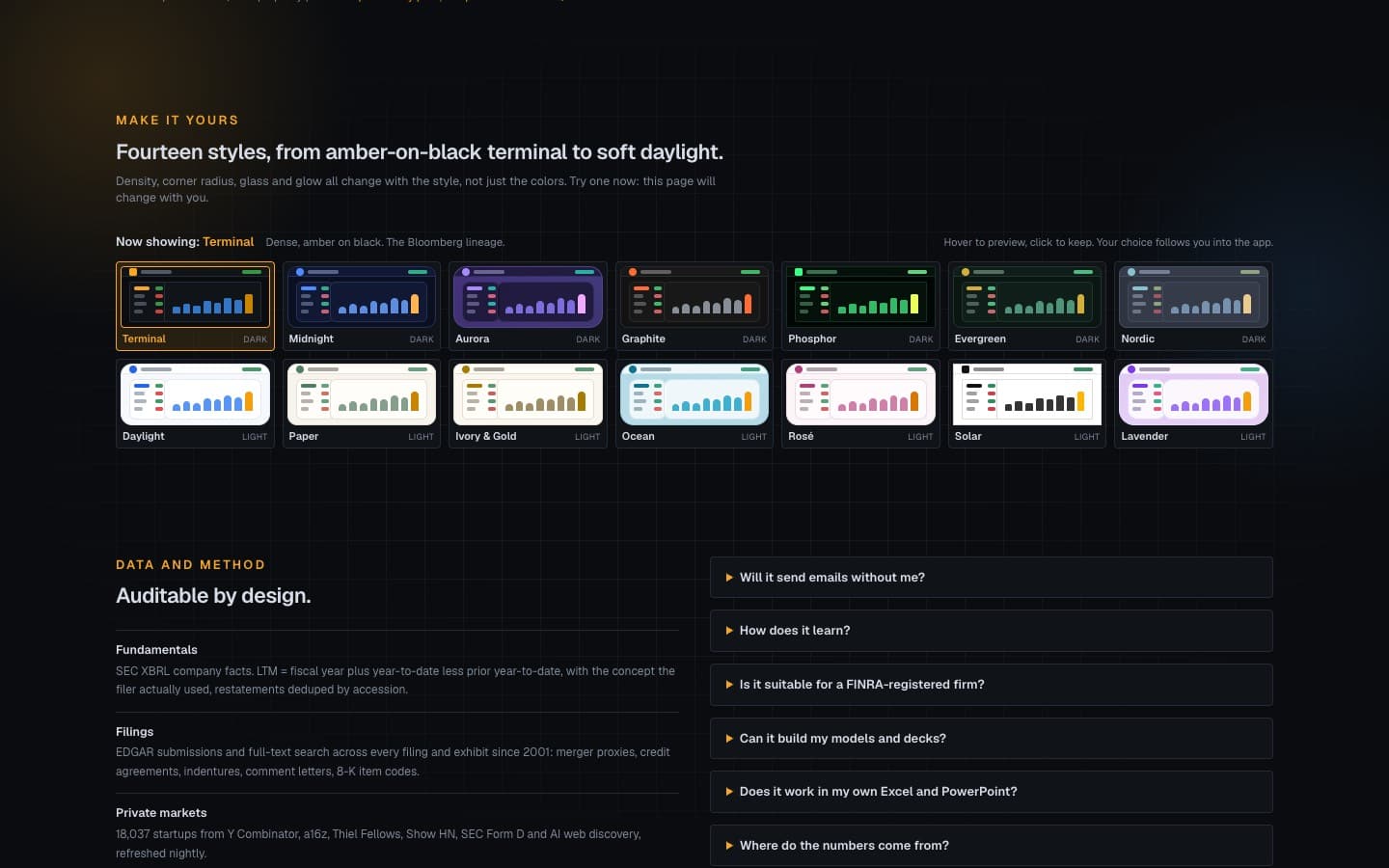
- styles, 7 dark and 7 light
- 14
ENGINE <GO>
Autonomy is earned, not switched on.
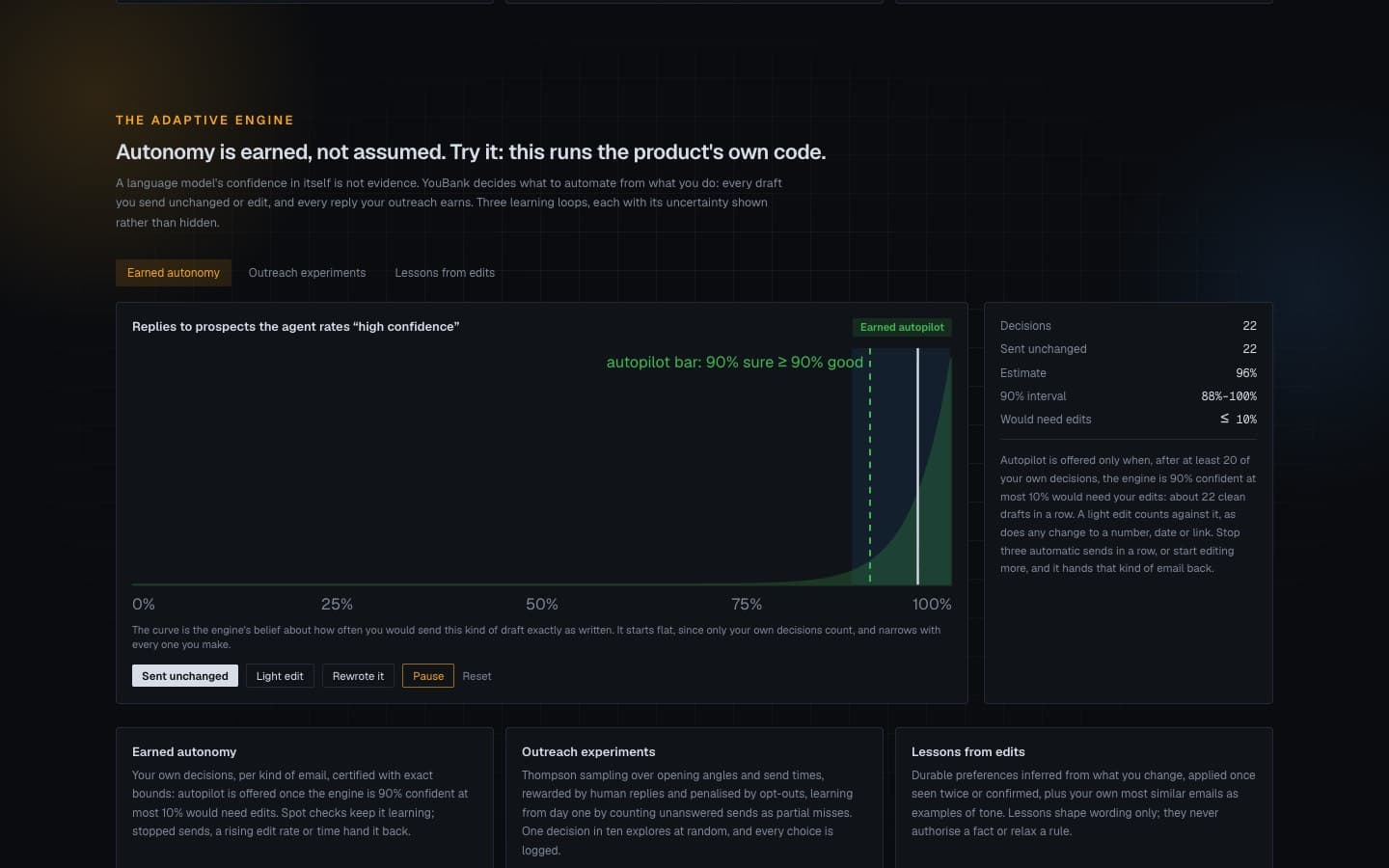
Every draft you send is a label. YouBank measures how much you changed it: word-level edit distance over the longer draft. A draft counts as good when that ratio is 0.05 or less and no critical field moved: a number, an amount, a percentage, a link, an email address, a weekday or a month.
No decisions yet
- Decisions
- 0
- Counted good
- 0
- Estimate
- 50%
- 90% interval
- 5%–95%
- Would need edits
- ≤ 90%
- Each sent draft is a label.
Autopilot is offered for a kind of email only after at least 20 decisions, and only when the engine is 90% confident that at most 10% of those emails would need edits. The engine keeps a Beta posterior per kind, with its own Beta CDF and quantile, Lanczos log-gamma and a seeded generator. The demo below runs the same rule.
- Loop 1Earned autonomyYour edits decide, per kind of email, when the agent may send alone.
- Loop 2Outreach experimentsThompson sampling over opening angles and send times, rewarded by replies and penalised by opt-outs.
- Loop 3Lessons from editsWhat you change in a draft becomes guidance for the next one.
FUNC <GO>
A terminal where the models are written down.
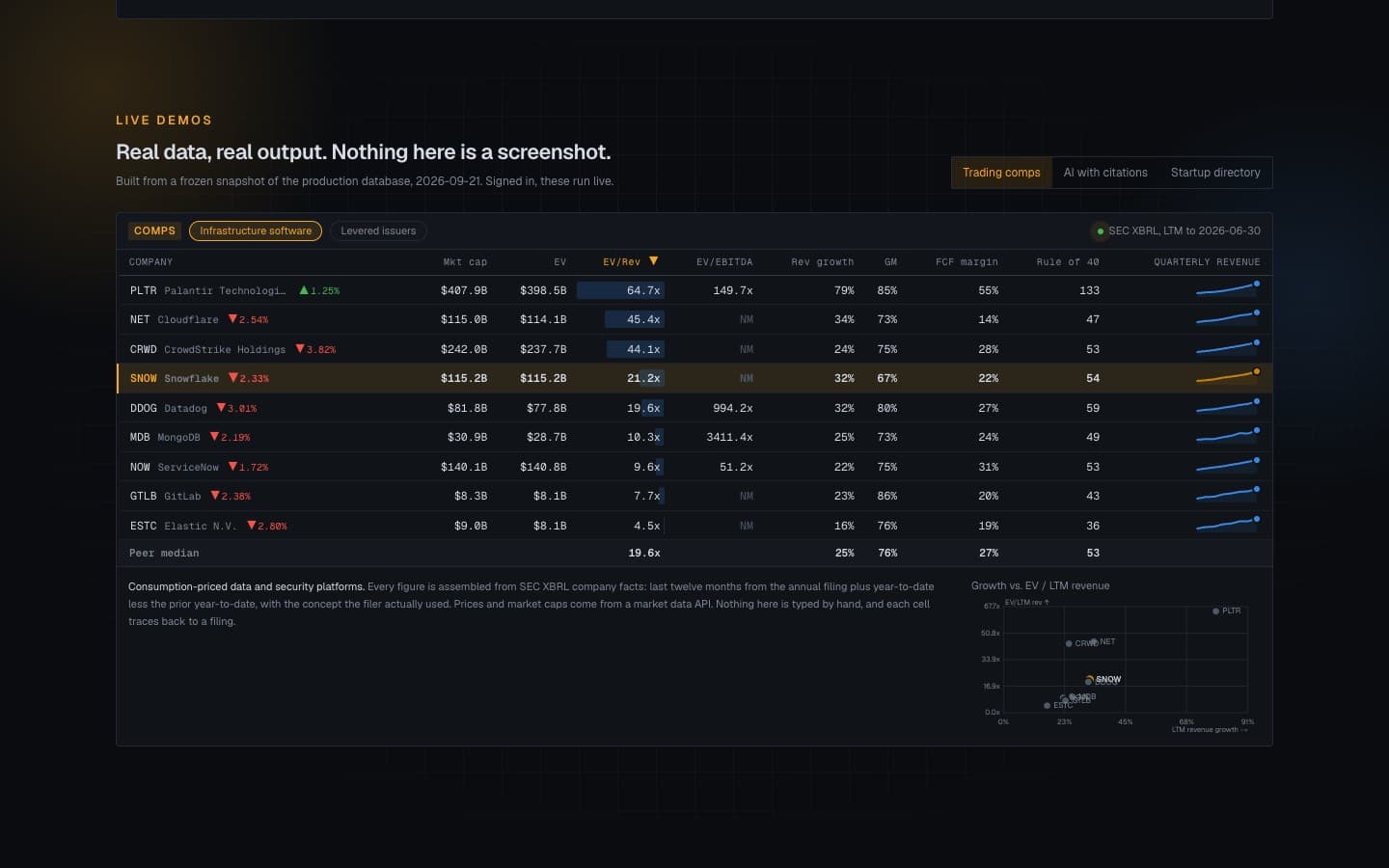
More than 35 functions, Bloomberg style. Company functions take a ticker, market ones don't, and some take plain words. Each screen can get an AI read in three bullets. A sample, with the methods behind them:
| Code | What it does | Methods | Typed as |
|---|---|---|---|
| GP | Price chart with a price cone | GARCH(1,1) | SNOW GP |
| BETA | Beta, four ways | OLS, Blume, Welch (2022) | SNOW BETA |
| RISK | Value at risk and expected shortfall | EWMA, GARCH, Cornish-Fisher, Kupiec backtest | SNOW RISK |
| WACC | Cost of capital | CAPM, implied-rating spread, Monte Carlo, tornado | SNOW WACC |
| IRAT | Implied credit rating | Altman Z'', Ohlson O, Merton distance to default | SNOW IRAT |
| QUAL | Earnings quality | Beneish M, Piotroski F, Sloan accruals | SNOW QUAL |
| FCST | Forecasts with honest intervals | M4 combination, conformal intervals | SNOW FCST |
| EE | Odds of an earnings beat | Beta-Binomial | SNOW EE |
| GC | Treasury curve and recession odds | Nelson-Siegel, NY Fed recession probit | GC |
| ECO | Macro dashboard | Damped trend, Sahm rule | ECO |
| EQS | Plain-English screener over every SEC filer | Words in, a screen out | EQS profitable software companies growing over 20% |
| PORT | Portfolio risk | Ledoit-Wolf shrinkage | PORT AAPL 40 MSFT 30 KO 30 |
| BTX | Backtest grader, A to F | Deflated Sharpe, PBO by CSCV, Harvey-Liu haircut | BTX |
| FACT | Factor Lab | Fama-French 2x3 on a point-in-time top-1,000 universe | FACT |
| LEARN | Learns which functions you know | Bayesian knowledge tracing: hints fade and new functions appear as you learn | LEARN |
Research tools only: YouBank is not investment advice and never places orders.
STUDIO <GO>
Watch the model build itself.
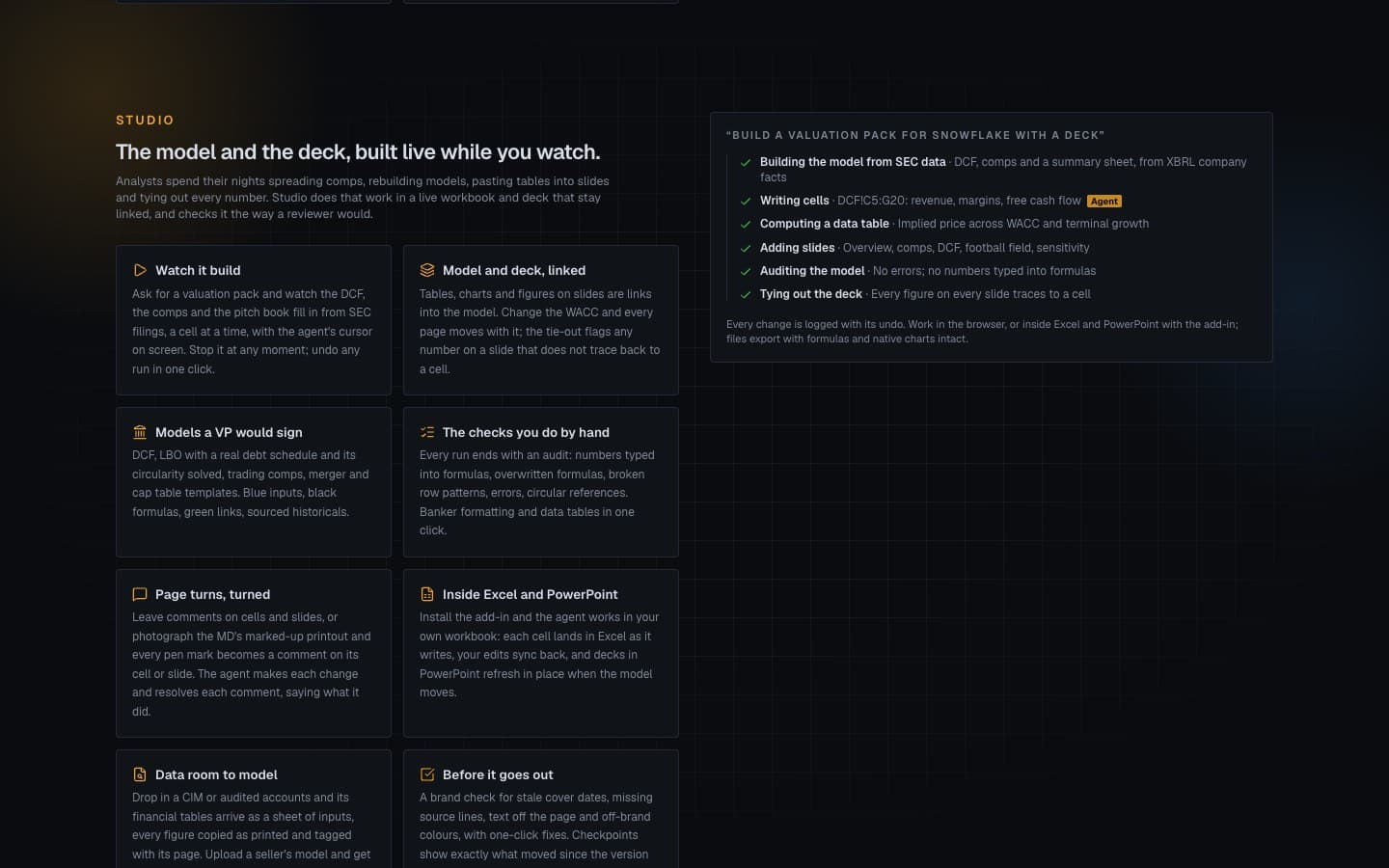
Studio is a live workbook and deck. The agent builds a DCF, LBO, comps or pitch book from SEC data cell by cell while you watch: cells glow as they are written, the agent's cursor is visible, and the view follows it across sheets.
Slides are linked to the model, so changing WACC moves every page. Each run ends with an audit health strip and an undo for the whole run. Deep mode runs up to 40 steps plus a review pass, and it exports to .xlsx and .pptx or works inside Excel and PowerPoint through an add-in.
| $M | FY26E | FY27E | FY28E | FY29E | FY30E |
|---|---|---|---|---|---|
| Revenue | 1,240 | 1,488 | 1,741 | 1,985 | 2,203 |
| Growth | 24.0% | 20.0% | 17.0% | 14.0% | 11.0% |
| EBIT margin | 8.0% | 11.0% | 14.0% | 16.0% | 18.0% |
| EBIT | 99 | 164 | 244 | 318 | 397 |
| Taxes | (21) | (34) | (51) | (67) | (83) |
| NOPAT | 78 | 129 | 193 | 251 | 313 |
| D&A | 50 | 60 | 70 | 79 | 88 |
| Capex | (62) | (74) | (87) | (99) | (110) |
| Change in NWC | (24) | (25) | (25) | (24) | (22) |
| Unlevered FCF | 42 | 90 | 150 | 207 | 269 |
| Discount factor | 0.913 | 0.834 | 0.762 | 0.696 | 0.635 |
| PV of FCF | 38 | 75 | 114 | 144 | 171 |
A toy version written for this page. Example Co. and its inputs are made up; the real Studio pulls its numbers from SEC filings.
AGENT <GO>
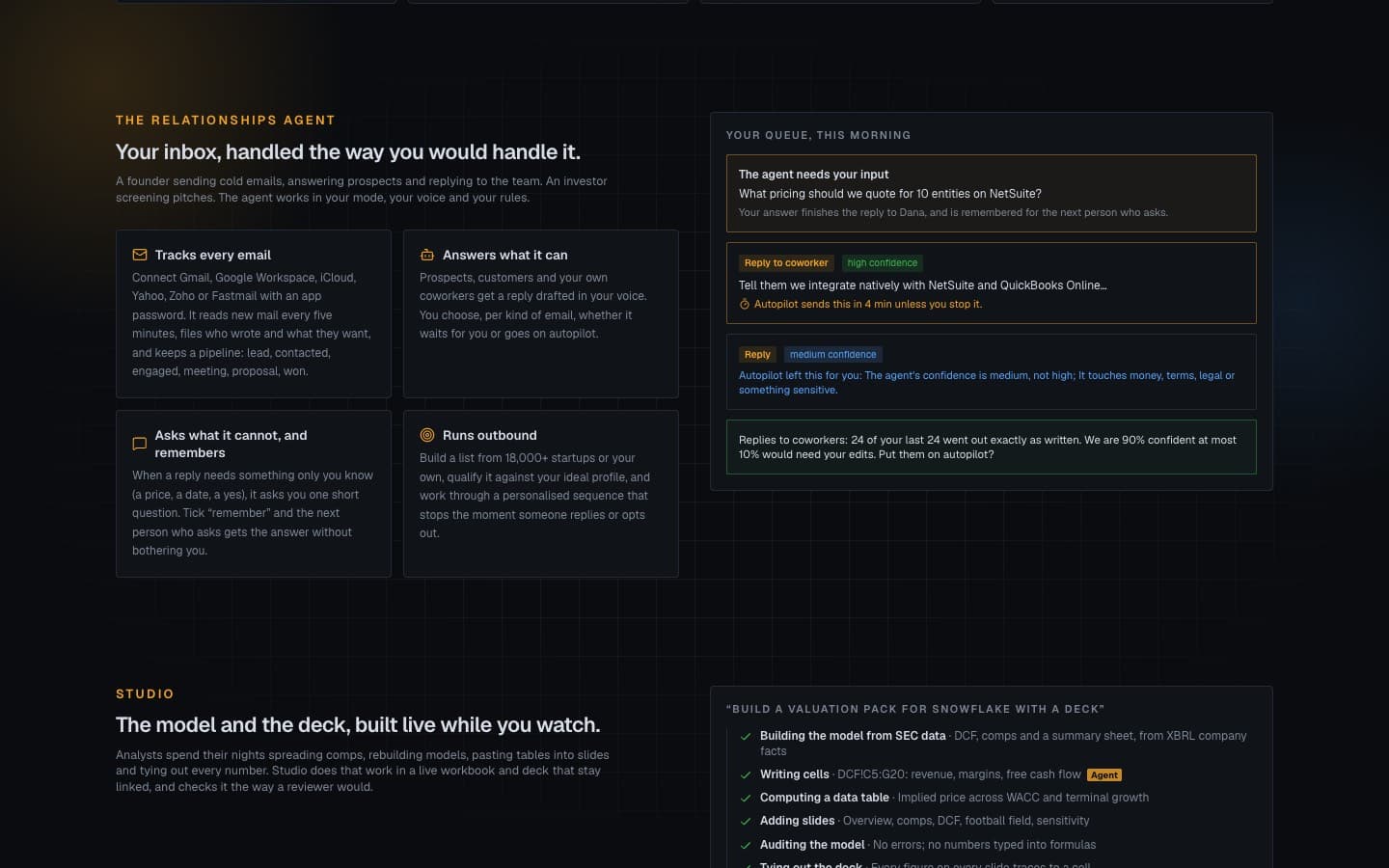
An email agent that asks before it guesses.
The email agent reads your mailbox, triages it and drafts in your voice. When it cannot answer something it asks you one question and keeps the answer in a playbook. It also runs outbound sequences from a directory of 18,000+ startups and keeps a pipeline from lead to won.
Only one function in the codebase sends mail, and it re-reads the live thread first. Anything the engine is unsure about is held in a review queue with its reasons.
- New mail
- Sync
- Resolve thread
- Triage
- Draft
- Consider
- Held with reasons, or scheduled
- Re-read live thread
sendDraft()the only code that sendslearnFromSend
NEWS <GO>
A newsroom that reads the filings first.
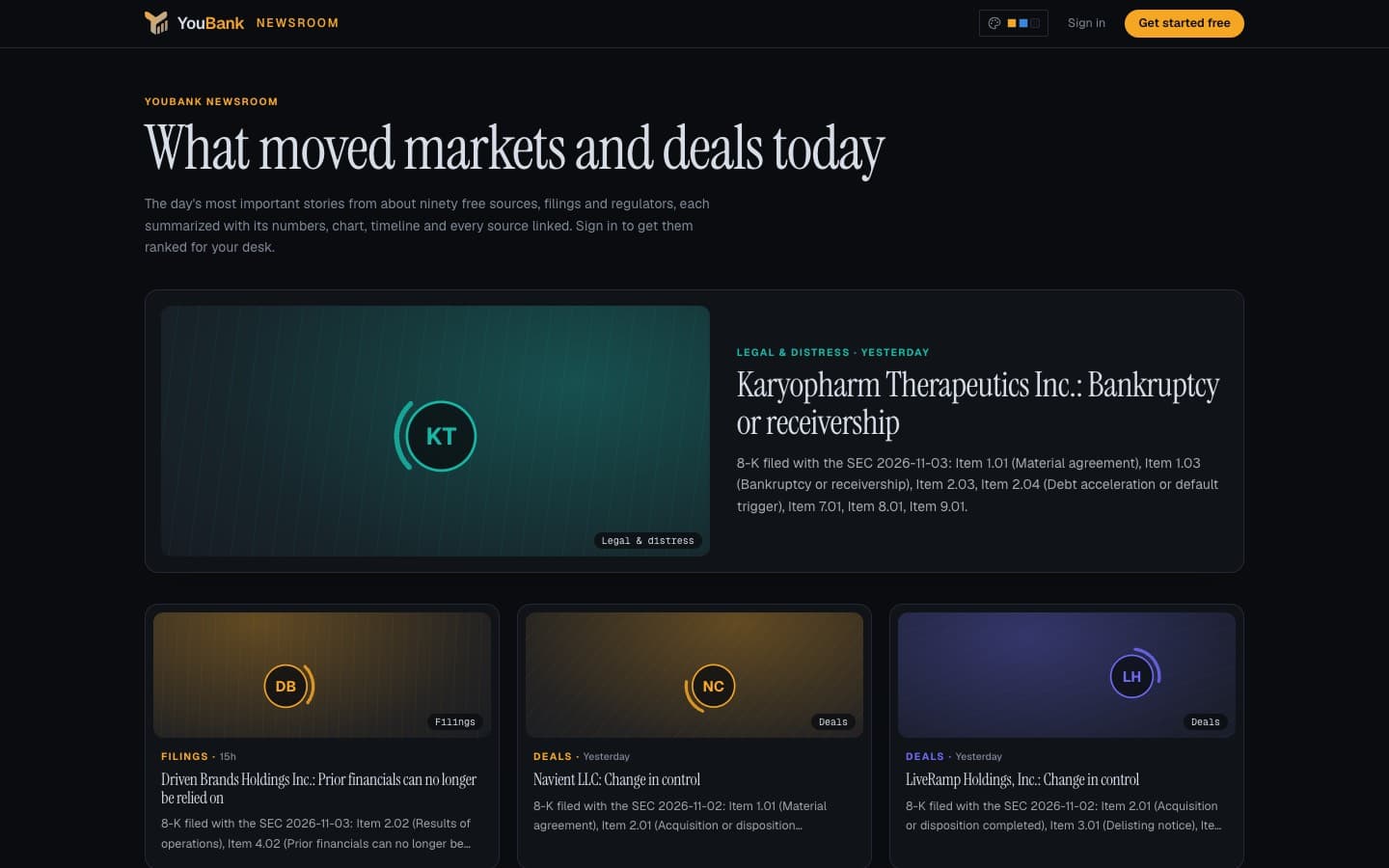
Every ten minutes the Newsroom reads about 90 free sources (publisher headlines, EDGAR filing signals, regulators and wires, and a radar per sector) and turns them into stories for each desk. Its public front page is open to anyone.
EDGAR8-K · Item 1.03· Restructuring
A bankruptcy filing goes to the top of the restructuring desk
EDGARSC 13D· Activism
An activist crosses 5%, with the stake, the date and the letter attached
EDGARMerger proxy· M&A
A merger proxy is parsed into the Precedent Engine, every term with its quote
EDGARS-1· ECM
A new IPO registration is read for the numbers that matter
Example cards showing the kinds of signals it reads, not live stories.
BUILD <GO>
How it is built.
One person, one TypeScript monorepo with Python and Rust where they earn their place. The README keeps a dated research log and the docs folder holds the persona research, decisions and specs.
- App
- Next.js 16 App Router, React 19, TypeScript, Tailwind v4 with generated theme tokens
- Data
- Neon Postgres through Drizzle, with 29 hand-written idempotent SQL migrations
- Auth
- Better Auth, self-hosted: Google and email/password
- AI
- OpenAI Responses and Anthropic Messages APIs with zod structured output; every model call logged with its token cost
- Sources
- SEC EDGAR submissions, XBRL company facts and full-text search; Financial Modeling Prep
- Jobs
- Vercel Cron for the morning sync and agent run, Neon Functions triggers every 20 minutes for autopilot and news
- IMAP/SMTP or the Gmail API; mailbox credentials encrypted with AES-256-GCM
- ML
- PyTorch services on Modal: a GraphSAGE model for M&A link prediction, and hybrid retrieval with cross-encoder reranking that lifted recall@5 from 0.85 to 0.97
- ml/
- Python cores for LBO, odds and edge models, with tests, and an optional GPU retraining job on Modal
- Quant
- Models written from scratch in TypeScript: GARCH volatility, VaR with backtests, Monte Carlo valuation, a Treasury yield curve, Altman, Ohlson and Merton credit risk
- Tests
- 1,000+ unit tests
- desktop/
- Tauri 2 app in Rust: tray, youbank:// deep links, a global Quick ask hotkey, an opt-in local agent
- Office
- Office.js add-in for Excel and PowerPoint
- Next.js
- React
- TypeScript
- Tailwind v4
- Neon Postgres
- Drizzle
- Better Auth
- OpenAI + Anthropic
- zod
- Python
- PyTorch
- Modal
- Rust
- Tauri 2
- Office.js
- Vercel
SCRN <GO>
Screens.
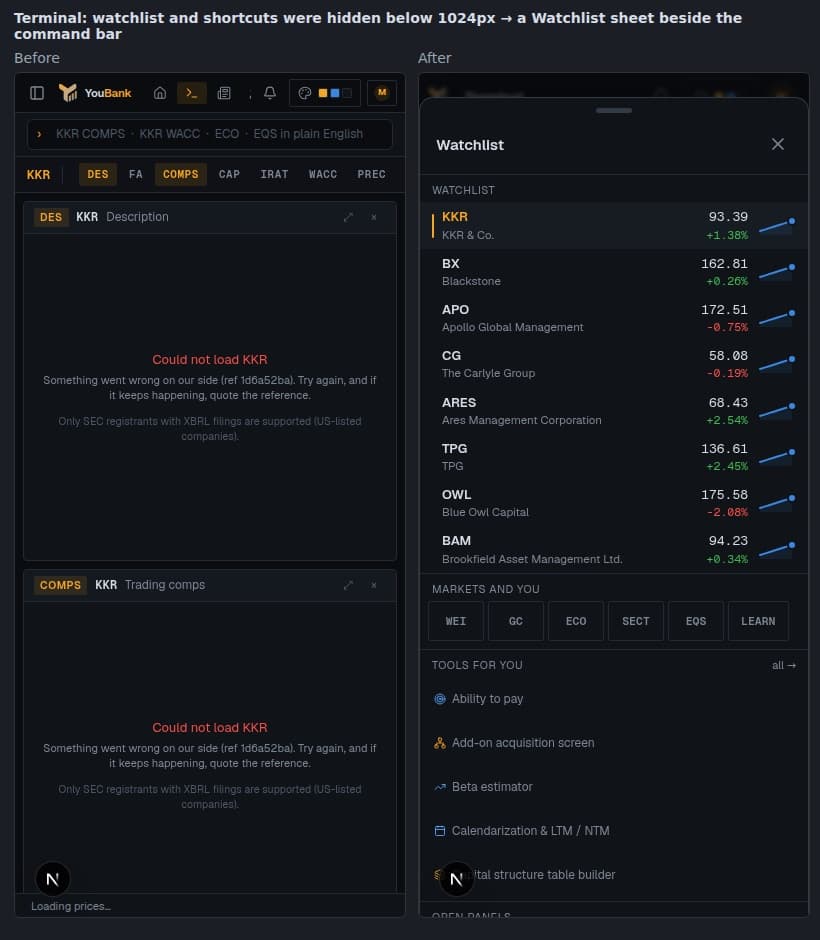
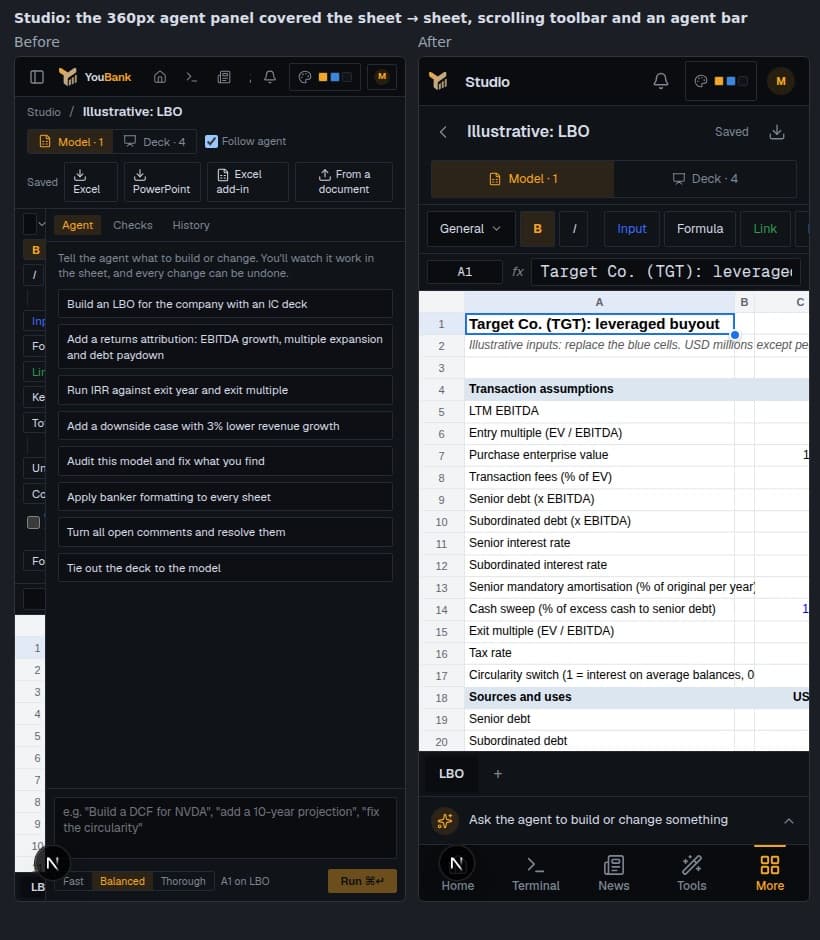
From the public site, plus two signed-in views on a phone that a visitor can't reach without an account.